
Tech giant Apple reported a record June quarter revenue of USD 109.4 billion, a 16 per cent year-on-year increase, with significant double-digit growth in emerging markets like India. However, the company anticipates business risks in the coming quarters due to rising memory chip prices and ongoing supply constraints.

The Indian government has approved the introduction of one billion polymer banknotes in Rs 10 and Rs 20 denominations for field trials, aiming to enhance durability. This move comes as the Finance Minister also addressed Parliament on declining retail inflation, GST reforms, and other fiscal measures taken to support the economy and household consumption.
Moody's Ratings has downgraded India's growth forecast for financial year 2026-27 (FY27) to 6 per cent from 6.8 per cent, attributing the revision to weaker consumption and industrial activity, elevated energy prices, and rising input costs stemming from the West Asia conflict.

ICICI Bank has successfully raised $1 billion through a five-year senior unsecured US dollar bond, marking its first public dollar bond issuance since 2017 and the largest single-tranche US dollar bond issuance by an Indian issuer so far this year.

The Rajya Sabha witnessed a heated debate between the opposition and the government regarding a discussion on the West Asia crisis, with accusations of political maneuvering and failure to uphold the dignity of parliamentary positions.

The conflict may disrupt Budget 2026-2027 projections, squeezing revenues and raising subsidies, prompting fiscal adjustments and potential reforms, echoing lessons from the Covid-era shock, points out A K Bhattacharya.

Prime Minister Narendra Modi convened a meeting with senior ministers to assess the impact of the evolving situation in West Asia on India's crude oil, gas, petroleum, power, and fertiliser sectors, focusing on ensuring uninterrupted supply and stable logistics.

The Nifty and Sensex outperformed Asian peers in South Korea, Japan, Taiwan and China.

Indian benchmark stock indices, Sensex and Nifty, closed nearly 1 per cent lower following the collapse of US-Iran negotiations, which heightened concerns of a prolonged conflict in West Asia and drove crude oil prices sharply higher.

Manipal Health Enterprises is set to launch India's largest healthcare initial public offering (IPO) on July 29, aiming to raise Rs 9,275.22 crore to fund expansion and debt reduction, with the issue closing on July 31.
The International Cricket Council (ICC) has cancelled its Board and committee meetings due to the ongoing military conflict in West Asia, according to a report by ESPNcricinfo on Tuesday.

VinFast has gone from an unknown brand to India's fifth-largest EV carmaker in just seven months, but its toughest battle is only beginning.

India's passenger vehicle industry is poised for a record-breaking year in 2026, propelled by robust dispatches in the first half of the calendar year and strong demand for utility vehicles, despite facing several economic challenges.

FIFA's proposal to create a $20 billion subsidiary for the World Cup, offering up to 20% stakes to external investors, aims to democratise global football finance but has been condemned by UEFA as selling the game's "soul."
The Indian government has implemented several measures to mitigate external risks, support the balance of payments, and maintain macroeconomic stability amidst the ongoing West Asia crisis, according to Minister of State for Finance Pankaj Chaudhary.

The Indian rupee depreciated by 52 paise to settle at 93.35 against the US dollar, driven by failed US-Iran peace talks, surging crude oil prices due to a potential US blockade of Iranian ports, and a global flight to the greenback. This geopolitical uncertainty is also leading to foreign capital withdrawal from domestic equities.

Indian equities on Dalal Street saw volatility as global market trends and fresh tariff concerns linked to Donald Trump impacted investor sentiment. Track Sensex, Nifty50 movement and key market drivers for April 9, 2026.
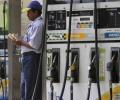
Sri Lankan President Anura Kumara Dissanayake has announced an economic relief package to mitigate the impact of the West Asia conflict, including fuel price reductions and support from India for petrol and diesel supplies.

"With the leverage available, I believe the scheme remains reasonably attractive," said P D Singh, India and South Asia Chief Executive Officer, Standard Chartered Bank, regarding the Foreign Currency Non-Resident (Bank) or FCNR (B) deposits.

India too can rise to the top if the 1.4 billion Indians back home are given better opportunities to use their innate talent and capacity to work hard, with right incentives in a more meritocratic rules-based system, asserts Ajay Chhibber.

Amidst global energy market volatility driven by the West Asia crisis, Russia has proposed increasing its crude oil and natural gas supplies to India, strengthening bilateral energy ties and aiming for USD 100 billion in annual trade by 2030.

That means making it easier to invest, protecting investors through predictable rules, and avoiding policy reversals after investments have been made, notes Rajeswari Sengupta.

Indian stock market indices Sensex and Nifty experienced a decline in early trade due to surging crude oil prices and ongoing geopolitical uncertainty in West Asia. Foreign fund outflows further contributed to the negative sentiment.

The International Cricket Council has announced significant format changes for the 2027 ODI World Cup and the 2028 T20 World Cup, aiming to increase competitiveness and consequence in both tournaments. The 2027 ODI World Cup will feature a Super Series and Super 7 stage, while the 2028 T20 World Cup will introduce a Super 10 stage after the group phase.

Prime Minister Narendra Modi convened the Cabinet Committee on Security to address the impact of the West Asia conflict on Indian citizens, focusing on safeguarding them from the conflict's effects and ensuring the smooth flow of essential supplies.

Akasa Air, despite facing headwinds from the West Asia conflict and rising aviation turbine fuel prices, expects to maintain a 30-40 per cent growth trajectory over the next five years and aims for an initial public offering (IPO) within two to four years, according to CFO Ankur Goel.

'We may be able to wind back some of the schedule reductions we'd taken in recent months.'

He added that opposition parties were assured that their concerns regarding the impact of the West Asia situation on India and the safety of Indian citizens were addressed in detail.
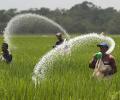
India's Central government is likely to see its fertiliser subsidy bill double to a record 3.4 trillion in FY27, up from the Budget estimate of 1.7 trillion, due to surging global fertiliser prices exacerbated by the West Asia war. This significant increase, coupled with revenue losses from excise duty cuts for oil-marketing companies, is straining the government's fiscal space, though capital expenditure plans remain unchanged.

Remittances from West Asia in March rose sharply amid the conflict in the region, with industry insiders estimating inflows to be 20-30 per cent higher than what is usual in a month.

Indian benchmark indices Sensex and Nifty surged significantly in early trade, mirroring a global rally and a sharp decline in crude oil prices following the finalisation of a peace deal between the US and Iran to end their 107-day conflict and reopen the Strait of Hormuz.

The Cabinet Committee on Security (CCS) has reviewed the evolving situation in West Asia, directing departments to assist Indian nationals affected by recent developments and emphasizing the need for dialogue and diplomacy.

Indian benchmark equity indices experienced a significant downturn, with the Sensex plummeting over 800 points and the Nifty falling sharply, driven by rising crude oil prices, geopolitical tensions, and foreign capital outflows.

The planned India-Japan annual summit, featuring Japanese PM Sanae Takaichi and Indian PM Narendra Modi, has been moved from Guwahati to New Delhi due to logistical issues and Takaichi's tight schedule. The summit, scheduled for July 1-3, aims to boost bilateral ties with discussions on investment, supply chain deals, energy resilience, and strategic oil reserves, accompanied by a delegation of 50 Japanese companies.

It, however, conceded that 20 per cent blending of ethanol with petrol leads to 3-5 per cent lower mileage in vehicles than conventional petrol, but said the blend offers a significantly higher octane rating, superior anti-knock properties, faster combustion, better pickup, smoother acceleration, and cleaner engine operation.

'Why not aspire for 8 or 9 or even 10 per cent?'

A potential US-Iran peace deal, expected to be signed on June 19, is anticipated to ease geopolitical stress and benefit various sectors, particularly in India, with analysts suggesting investors await finer details before making significant moves.

The World Bank has increased India's economic growth projection for FY27 to 6.6 per cent, citing resilient domestic demand, while simultaneously cutting its global economic growth outlook due to the conflict in West Asia.

A Lenovo study reveals that Indian enterprises are planning to increase their investments in Artificial Intelligence (AI) at a higher rate than other countries in the Asia-Pacific region.
The Japanese PM's visit to Assam comes amid festering uneasiness in Tokyo about Beijing's assertiveness in the Indo-Pacific region.
